ZCWA Robot VacuumOfficial Website
Guide · Routine

How Often Should You Run a Robot Vacuum

ZCWA Product TeamReviewed 2026-07-286 min read

Daily, in most homes. The instinct is to treat a robot vacuum like a conventional vacuum and run it weekly, but that misunderstands what it is good at. It cleans lightly and covers ground cheaply, so its advantage comes from frequency: a floor cleaned every day never reaches the state that needs a thorough clean.

Why frequency beats thoroughness

A conventional vacuum is used occasionally and works hard: high suction, a driven brush, deliberate passes, and a person applying pressure. A robot is the opposite — light, unattended, and cheap to run. Comparing the two on a single pass makes the robot look weak, and that comparison is what leads people to schedule it weekly.

Run daily, the arithmetic changes. Dust and hair are removed the day they land, before they are walked into carpet or driven into the joints of a wood floor. Nothing accumulates, so nothing needs to be recovered. The robot never faces a difficult job because it never lets one form.

How often, by household

A starting schedule by household type
HouseholdVacuumingMoppingWhy
One or two adults, hard floors, no petsEvery 2–3 daysTwice a weekLow shedding load; dust is the main input
Family with childrenDaily3–4 times a weekCrumbs and spills arrive continuously
One shedding petDailyTwice a weekHair accumulates visibly within 24 hours
Multiple petsDaily, twice in shedding season3–4 times a weekThe 0.2–0.5 L bin is the limiting factor
Allergy or asthma in the householdDailyDailySettled dander is the target; consistency matters more than power
Mostly carpetDaily light pass, weekly uprightN/AThe robot maintains; an upright does the deep work
Holiday home or occasional useBefore and after each stayBefore each stayDust settles regardless of occupancy

What to schedule around

  • An empty house. The noise bothers nobody and the floor is clear. Mid-morning on weekdays is the usual answer.
  • Before the floor is used, not after. Running before dinner rather than after means the robot is not competing with a table full of people.
  • Pet feeding times. A robot arriving mid-meal is disruptive for an animal and messy for the robot.
  • The tidy-up. Two minutes of picking up cables, socks and rug tassels prevents almost every stoppage. Attaching that habit to a fixed schedule is what makes it stick.

Mopping is a separate schedule

Mopping frequency is limited by the cloth rather than by the floor. The cloth has to be rinsed and hung to dry after every use, and left damp on the robot it sours within a day. In practice that caps most households at two to four mops a week even where daily would be welcome.

Kitchens are the exception worth making. A daily mop in a kitchen, with the rest of the house on twice a week, is a sensible pattern on any robot that lets the tank be removed easily. The reasoning behind what a robot mop can achieve is in the mopping guide.

What daily use costs

Consumable and battery impact of a daily schedule
ItemWeekly useDaily use
Filter replacementEvery 4–6 monthsEvery 2–3 months
Side brushesEvery 12 monthsEvery 6–9 months
Battery cycles per year~52~365
Expected battery service life4–5 years2–3 years
ElectricityNegligible either way — a robot vacuum draws a few pence of electricity per month

The honest summary: daily running roughly halves battery service life and doubles consumable consumption, in exchange for a floor that is clean every day rather than one day in seven. On a robot in this price class that is a straightforward trade. Battery care is covered in the maintenance guide.

On a robot without mapping

Runtime, coverage per charge and charging time are on the specification page, and they set the practical ceiling on any schedule. Non-mapping robots, including the ZCWA BR151, cannot be told to clean the kitchen on Monday and the bedrooms on Tuesday. Coverage is whatever the robot can reach in one run. In a small flat that is the whole floor and the question does not arise; in a larger home the practical technique is closing doors to control where it goes, and running it twice on the days that matter.
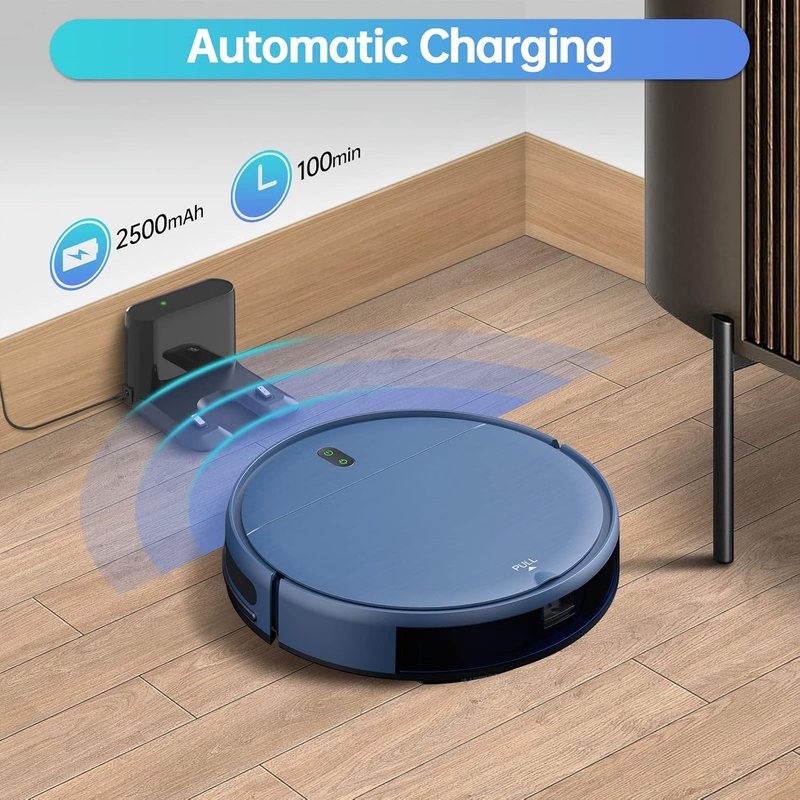
ZCWA robot vacuum BR151 returning to its charging dock, with 2500 mAh battery and 100 minute runtime labelled
Model BR151 · ASIN B0B81SWDL1

ZCWA Robot Vacuum and Mop Combo (Blue)

  • 1400 Pa suction with a brushless intake, so long hair passes straight into the 0.2 L dustbin instead of winding round a roller
  • 230 ml electronic water tank with two flow levels for laminate, tile, granite and sealed parquet
  • 2500 mAh battery, roughly 100 minutes of cleaning and up to 1290 sq ft per charge, then it finds the dock on its own
  • 2.87 in tall — clears the gap under most sofas, beds and kitchen kickboards

Scheduling FAQ

How often should a robot vacuum run?

Daily in most homes, and that is not excessive. A robot vacuum is a maintenance tool: running it every day keeps a floor from ever becoming dirty, which is a much easier job than cleaning a dirty floor. Homes with pets or children generally need daily; a single person on hard floors with no animals can reasonably drop to every second or third day.

Does running a robot vacuum every day wear it out?

It consumes battery cycles and consumables faster, which is real but modest — roughly a filter every two months instead of every four. Set against a floor that stays clean, that is a good trade. Nothing in the mechanism is damaged by frequent use.

How often should the mopping function be used?

Less often than vacuuming. Two to four times a week suits most hard-floor homes, and daily is reasonable in a kitchen or a home with a dog that goes outdoors. The cloth has to be rinsed and dried after every use, which is the practical limit on frequency.

Is it better to run a robot vacuum at night or during the day?

While the house is empty, if possible: nobody is inconvenienced by the noise and there is nothing on the floor to obstruct it. Overnight works too, though a robot that gets stuck at 2 am will sit there until morning rather than finishing its run.

Should a robot vacuum run in every room every time?

On a robot with mapping, no — rotating rooms across the week is more efficient. On a non-mapping robot like the ZCWA BR151 the choice does not exist in software, so the equivalent is closing doors to rooms that do not need it that day.

Check Price

This site uses cookies to measure traffic. Nothing is loaded until a choice is made. Read the Cookie Policy.