How Robot Vacuums Navigate: Random, Gyroscopic and Lidar
Robot vacuums navigate in one of three ways. Random-route robots bounce off obstacles and cover a room by repetition. Gyroscopic robots track their own heading and drive roughly parallel lines without a map. Lidar robots spin a laser rangefinder, build a saved floor plan and clean it methodically. The differences show up in price, in cleaning time, and in how tall the robot has to be.
The three approaches
Random route
The oldest and cheapest approach. The robot drives in a straight line until a bumper or an infrared sensor tells it something is there, turns through some angle, and continues. There is no memory of where it has been. Coverage is a statistical outcome: run it long enough in a bounded space and most of the floor gets crossed.
This sounds crude and it is, but it has real advantages. There is no turret, so the robot can be made very low. There is nothing to calibrate, so it works the moment it is switched on. It costs a fraction of a mapping robot. And in a small flat, the difference in outcome after a full cycle is much smaller than the specification sheet suggests.
The weakness is large open floors. Coverage that is reliable across 40 square metres becomes patchy across 120, and the robot may run out of battery before it has covered the space once.
Gyroscopic route
A step up. An inertial sensor lets the robot track its own heading, so instead of turning through an arbitrary angle it can turn 180 degrees and drive back parallel to its last pass. The result is a boustrophedon pattern — the Z-shaped or lawnmower route — that covers a rectangle far more efficiently than randomness does.
Gyroscopes drift. Over a long run the parallel lines stop being parallel and the pattern degrades, which is why gyroscopic robots usually mix this mode with random behaviour rather than relying on it for a whole cycle. The ZCWA BR151 works this way: a random route combined with a Z-shaped route, which is what the specification means when it lists both.
Lidar and vSLAM
A spinning laser rangefinder, or in the vSLAM variant a camera, measures distances continuously and builds a floor plan the robot stores and reuses. Once a map exists, everything people expect from a modern robot becomes possible: clean this room only, avoid that corner, resume where the battery ran out, show the route on a phone.
What it costs is money and height. A lidar turret adds roughly an inch to the top of the robot, which is the difference between fitting under a sofa and not fitting under it. That is a genuine trade, not a marketing detail — in many homes the dirtiest floor is exactly the floor under the furniture.
Compared
| Random | Gyroscopic | Lidar / vSLAM | |
|---|---|---|---|
| Saved floor map | No | No | Yes |
| Room selection | No | No | Yes |
| Virtual no-go zones | No | No | Yes |
| Resume after charging | No | Sometimes | Yes |
| Coverage efficiency | Low | Medium | High |
| Typical body height | Lowest | Low | Tallest |
| Works in the dark | Yes | Yes | Lidar yes, vSLAM often not |
| Relative cost | Lowest | Low | Highest |
| Best suited to | Small flats, daily light passes | Small to mid-size hard-floor homes | Large or multi-room homes |
Which one a floor actually needs
The honest answer depends on floor area more than on anything else. Under about 70 square metres of mostly open hard floor, a gyroscopic robot run daily keeps the floor in much the same state a lidar robot would, because the job is maintenance rather than recovery. Above that, or across several separated rooms, the absence of a map starts to cost real coverage and the case for lidar becomes straightforward.
The second factor is furniture. A home where most of the dust lives under a low sofa is a home where a 2.87 in robot that wanders beats a 3.9 in robot that plans, simply because one of them can get to the dirt.
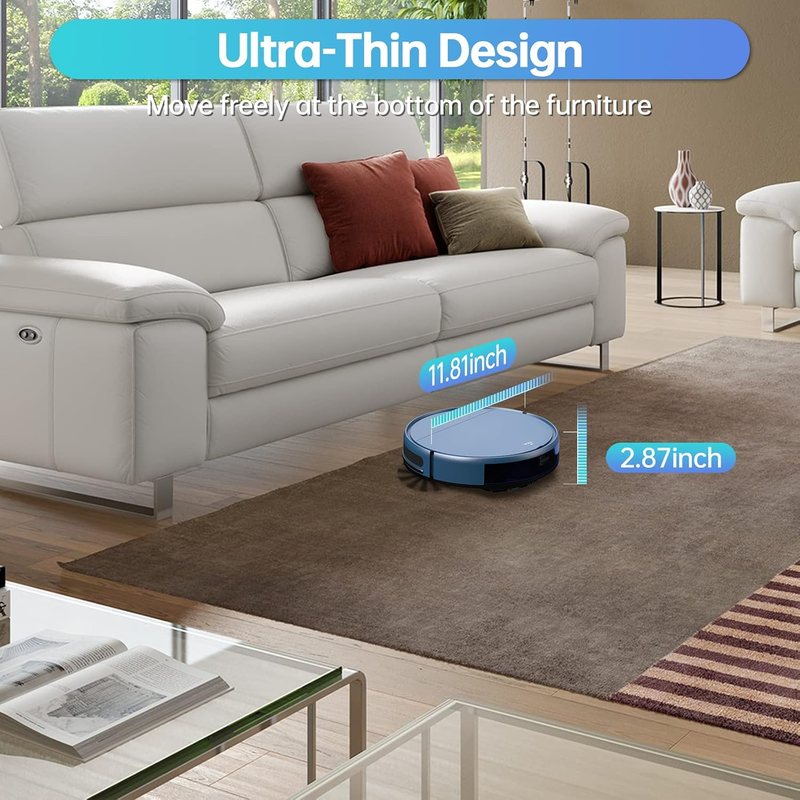
Where the ZCWA BR151 sits
The BR151 is a gyroscopic-and-random robot with 3D obstacle sensors and anti-drop sensors at stair edges. It has four route patterns — Auto, Zig-zag, Edge and Spot — and no saved map. On a large open floor, choosing Zig-zag over Auto measurably improves coverage, because it leans on the heading sensor instead of on randomness.
The full route and sensor list is in the BR151 specification. What it will not do is clean one room on request, avoid a pet bowl by software, or pick up where it left off after recharging. Those are map features and this is not a mapping robot. The full specification states this plainly, and the reviews page notes that buyers who missed it are the ones who end up disappointed.
Navigation FAQ
What is the difference between random and lidar navigation?
A random-navigation robot has no map. It drives until something stops it, turns and carries on, covering a room by repetition and statistics. A lidar robot spins a laser rangefinder, builds a floor plan, and drives that plan in deliberate parallel lines. Lidar finishes faster and misses less; random navigation costs a fraction as much and gets there eventually.
Does the ZCWA BR151 use lidar?
No. It uses a random route combined with a Z-shaped route, guided by 3D obstacle sensors and anti-drop sensors. There is no laser turret, which is also why the body is only 2.87 in tall and fits under furniture that lidar robots cannot reach.
Why does a robot vacuum go over the same spot twice?
On a non-mapping robot that is the coverage strategy, not a fault. Overlap is how a random route guarantees that most of the floor gets cleaned. The trade-off is that a small part of the floor gets cleaned three times and a small part gets missed.
Can a robot without mapping be told to skip a room?
Not in software. A non-mapping robot has no concept of rooms, so no-go zones and room selection are unavailable. The physical equivalents are closing the door and putting a low barrier across an opening.
Related guides
Choosing a robot vacuum for pet hair →
The roller brush is the part that fails in a home with animals. What to look at instead of suction figures, and the maintenance a pet home really involves.
Robot mopping on hard floors: what it can and cannot do →
A robot mop wipes; it does not scrub. The difference between gravity pads and metered tanks, which floors are safe, and why water flow is the fault people report most.
The robot vacuum maintenance schedule →
Nine parts, four intervals. What to clean daily, weekly, monthly and quarterly, and the early signs that something is about to stop working.